SAN DIEGO MOBILE PAINTLESS DENT REPAIR
SAN DIEGO MOBILE PAINTLESS DENT REPAIR
Get a paintless dent repair estimate from The Dent Devils. We provide mobile paintless dent repair throughout San Diego County for door dings, dents, creases, body-line damage, hail damage, aluminum body panels, electric vehicles (EVs), and other repairable damage. Paintless Dent Repair can preserve your vehicle’s original factory paint, reduce repair time, and in many cases provide an alternative to filing an insurance claim — helping you avoid a claim-related damage record that could affect your vehicle’s CARFAX history and resale value.
Take photos outside in natural daylight, preferably in direct sunlight.
Take one straight-on photo so we can see the entire damaged panel.
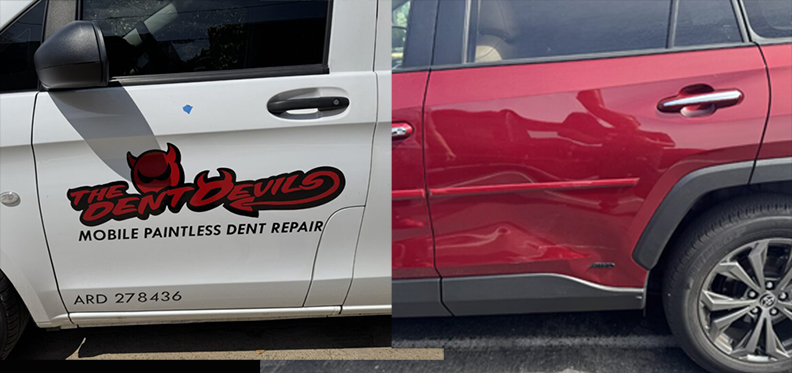
If you have a small ding or multiple dings, place a small piece of blue tape or a Post-it about 3 inches above each ding. Photograph the entire damaged area, not just the dent itself, as shown in the example below.
Don’t get too close. We need to see the entire damaged panel and the area around the dent.
Take a 30–60 second video in good daylight of each damaged area. Short 10-second videos usually don’t provide enough detail.
Start far enough back to show the entire damaged panel and the dent’s location.
Keep the camera focused on the center of the damage while moving around it from different angles. Move slowly from side to side, up and down, and around the damage, while keeping the center of the dent in the frame. Don’t hold the camera in one position. The changing angles and reflections help us see the true depth, shape, and size of the damage.
Damage can extend well beyond what you see in the center of the dent. As the panel flexes, impact energy can create subtle crowns and pressure points around the damaged area. Even a baseball-sized dent can transfer energy one to two feet across the panel, which is why showing the entire panel and moving around the damage is so important.
The better we can see the damage, the more accurately we can evaluate your repair before scheduling an appointment.
If your video will not upload, please let me know in the Additional Comments. After I reply, you can respond to my email with the video attached, or simply text the video to 619-726-6767. Thank you!
Required fields are marked with an *
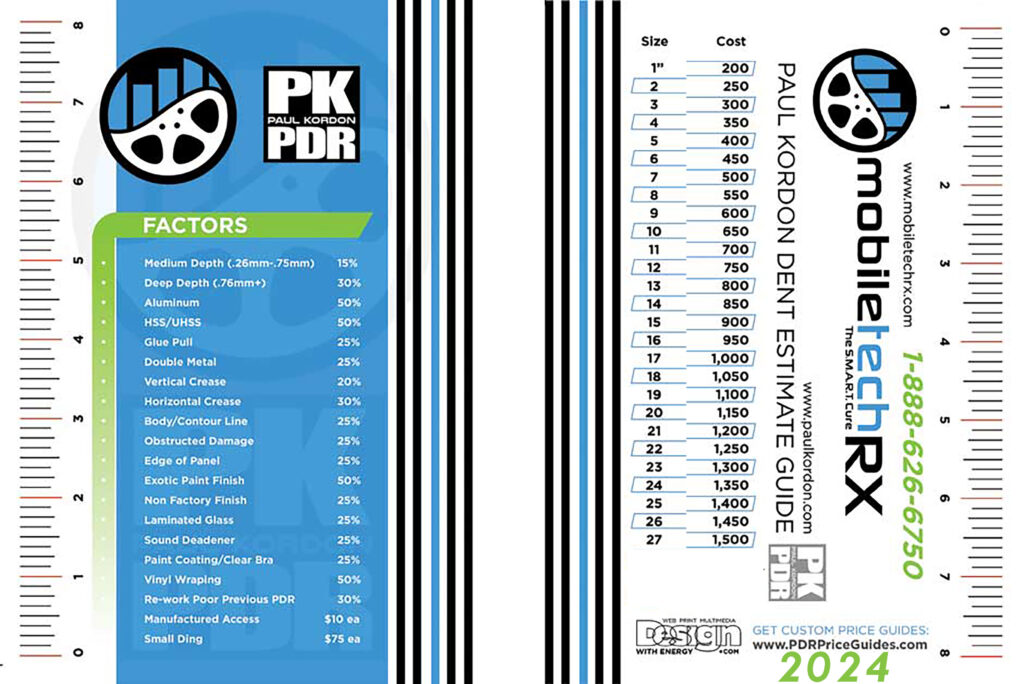
The difficulty and cost of Paintless Dent Repair (PDR) depend on much more than just the size of the dent. Factors include:
Working conditions — a controlled garage environment provides better lighting and temperature control, while working outdoors in direct sunlight, heat, wind, or changing light conditions can increase the difficulty of the repair.
Depth and sharpness of the damage — deep dents, sharp creases, and concentrated impact points are always more difficult to repair than shallow damage of the same size and location.
Access behind the panel — including whether parts must be removed for proper tool access, whether internal bracing or structure restricts access, or if limited access requires alternative PDR techniques such as glue pulling.
Panel materials—aluminum, high-strength steel, and others—respond differently during the repair process.
Location of the damage — body lines, panel edges, tight contours, and complex panel shapes can be considerably more difficult to repair than damage in open areas of a panel.
Color and finish of the vehicle — colors such as white, silver, and gold, as well as 3-stage pearls and matte finishes, can make subtle highs, lows, and other imperfections more visible, especially when repairing stretched damage.
Size of the damage — larger damaged areas generally require more time and correction to achieve the desired result.
Paint texture — whether the factory finish has orange peel or a flatter finish can affect how easily subtle highs, lows, and imperfections are seen during and after the repair.
Previous paint or body repairs — repainted panels, body filler, or prior repairs — may affect which PDR techniques can be used safely. Glue pulling on previously repainted panels can also increase the risk of paint lifting or failure.
Paint system — 2-stage, 3-stage, pearl, and other multi-stage paint systems can affect how precisely the finished repair must be worked to minimize visible distortion or imperfections.
Overall condition of the paint — age, cracking, peeling, previous damage, or other paint conditions may affect the repair process. Poor or compromised paint may make the damage unsuitable for glue pulling, while extreme Paintless Dent Repair can significantly increase the risk of paint cracking, lifting, or failure.
Ceramic coatings, Paint Protection Film (PPF), or vehicle wraps may affect repair methods. Glue pulling may be risky or not recommended on these surfaces due to the potential for damage to coatings, films, wraps, or paint. In some cases, PPF or wraps may need to be removed before the repair can be performed.
Desired repair outcome — whether the customer is looking for an improvement-only repair or the highest achievable level of finish.
The Dent Devils uses Mobile Tech RX professional estimating software to calculate Paintless Dent Repair (PDR) pricing based on the specific factors for each repair.
“The bitterness of poor quality remains long after the sweetness of low price is forgotten. ”