
SAN DIEGO MOBILE PAINTLESS DENT REPAIR
SAN DIEGO MOBILE PAINTLESS DENT REPAIR
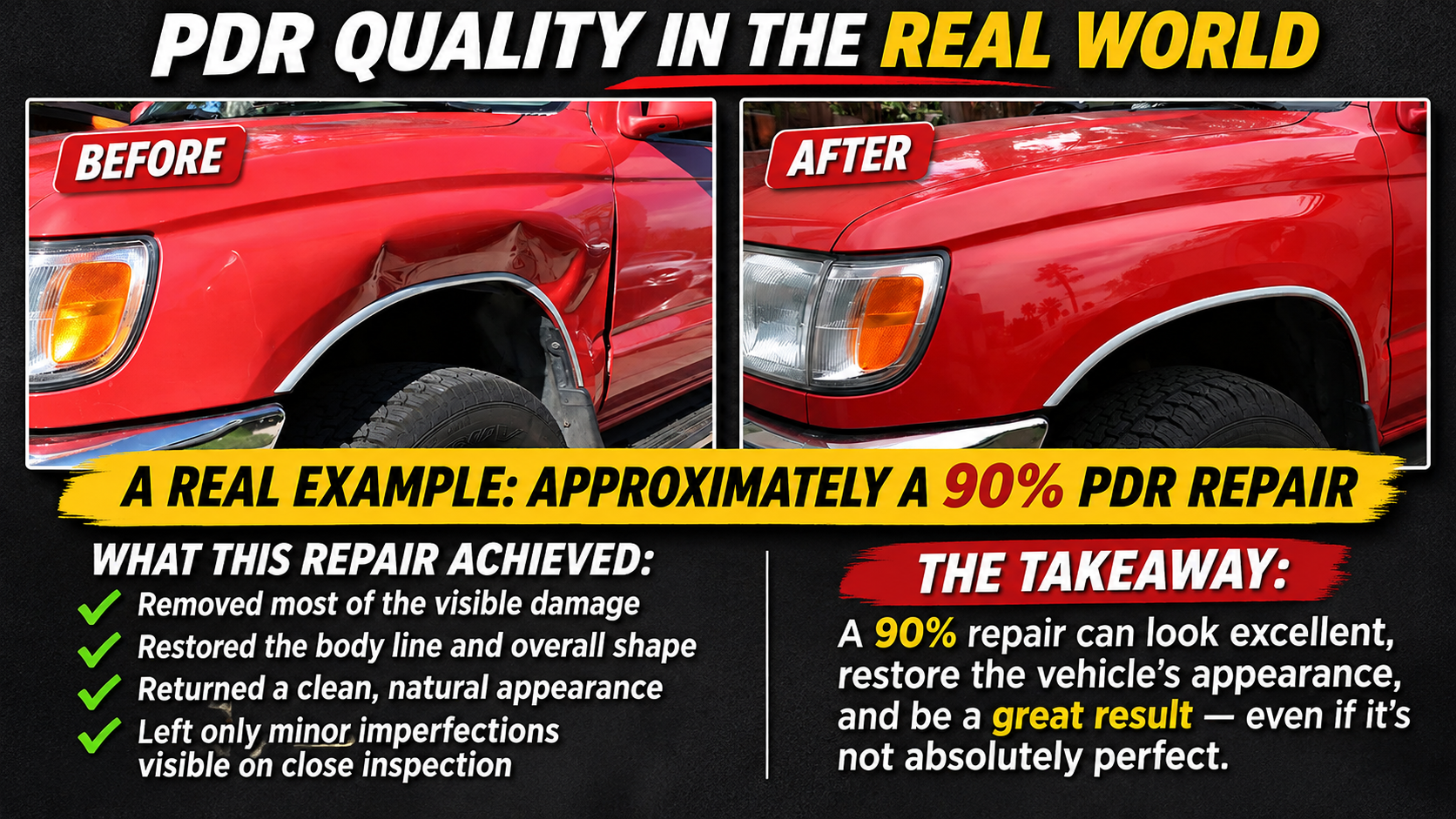
Just because 90% of a dent is gone doesn’t mean you’ve achieved a 90% repair. And just because a dent looks perfect in a photograph doesn’t mean the metal is finished.
In the PDR industry, percentages get thrown around as if everyone agrees on what they mean.
“I can get that 90%.”
“That’ll be about an 80% improvement.”
“Looks 100% to me!”
Really? According to whose standards?
A panel can look flawless from 10 feet away and resemble a swimming pool when you roll a reflection across it.
Are we measuring how much of the dent was removed, how closely the panel resembles its original condition, or simply how much better it looks?
Those are three very different things.
No universally accepted industry standard assigns percentages to PDR results.
The following scale is my proposed visual reference, based on decades of automotive metalworking experience—not an official industry grading system. It helps technicians and customers set realistic expectations.
These descriptions assume inspection in natural daylight from approximately 5–10 feet, straight on and from multiple angles. Critical inspection involves reflected straight lines or professional PDR lighting.
100% – Factory-Level Restoration
Restores original contours, body lines, texture, and reflections. No evidence of the damage is detectable, even under critical inspection.
Severely stretched metal, sharp impacts, or restricted access may make this impossible.
90% – Near-Factory Restoration
Virtually undetectable during normal viewing. Reflections appear natural, but a trained eye may find very minor flutter, texture differences, or distortion under critical lighting.
80% – Very Good Restoration
The overall shape is restored, but minor highs, lows, waves, or stretched-metal distortion may be visible in natural light or from certain angles.
70% – Significant Improvement
The dent is substantially reduced, but noticeable imperfections remain, including distorted reflections, waves, or irregular body lines.
60% – Moderate Improvement
The dent is shallower and less severe, but obvious damage remains, including distorted contours, highs, lows, or stretched metal.
50% or Less – Basic Cosmetic Improvement
The damage is reduced rather than fully restored. Significant evidence of the original dent remains.
| Restoration | Normal viewing (5–10 feet) | Critical inspection |
|---|---|---|
| 100% | No detectable damage | Factory-consistent reflections |
| 90% | Virtually undetectable | Very minor imperfections |
| 80% | Minor imperfections visible | Identifiable distortion |
| 70% | Noticeable imperfections | Moderate distortion |
| 60% | Obvious remaining damage | Significant distortion |
| 50% or less | Substantial damage remains | Major distortion |
These percentages are subjective visual categories, not scientifically measured results or guarantees.
A technician might remove 90% of a dent’s depth while leaving stretched metal, crowns, highs, lows, or distorted reflections.
The panel may be considerably flatter but still look damaged.
Dent reduction describes how much damage has been reduced. Visual restoration describes how closely the finished panel resembles its original appearance.
They’re not interchangeable.
And photographs don’t always reveal the difference.
Lighting, paint color, camera angles, and reflections can make a repair look flawless in one image while hiding significant distortion.
A repair that photographs well isn’t necessarily a well-finished repair.
Getting a panel relatively flat is often the easy part.
High-level PDR requires controlling metal displacement, stretching, crowns, highs, lows, body lines, and surrounding tension.
The first 70% of a repair may happen relatively quickly.
The next 20% can require considerably more patience.
And that final 10%?
It may take longer than everything that came before it—or may not be physically achievable.
Removing the dent is one thing. Finishing the metal is another.
Two technicians can remove about the same dent depth yet produce very different finished results.
The difference often comes down to metal control, reflection management, finishing ability, and knowing when to stop.
| Evaluation | Improvement repair | High-end PDR correction |
|---|---|---|
| Primary goal | Reduce visible damage | Restore factory-like appearance |
| Crowns and tension | May remain partially unresolved | Carefully controlled |
| Highs and lows | Some remain visible | Minimized through detailed finishing |
| Body lines | Generally improved | Closely restored |
| Reflections | Some distortion remains | Natural, factory-consistent appearance |
| Stretched metal | May limit the result | Managed as far as physically practical |
| Finishing time | Limited by agreed scope | Additional time devoted to refinement |
| Expected result | Noticeably better | Closest practical restoration |
A highly experienced technician may deliberately perform an improvement-only repair because that’s what the customer requested.
An 80% restoration doesn’t automatically mean poor workmanship, just as a promised 90% restoration doesn’t guarantee quality.
Judge workmanship by skill, care, methods, and whether the agreed-upon expectations were met.
PDR percentages are subjective estimates, not industry-certified measurements or guaranteed results.
Actual outcomes depend on damage severity, metal stretching, panel construction, accessibility, paint condition, previous repairs, and concealed structural components.
Some limitations may not become apparent until work begins.
Before authorizing a repair, understand:
A more expensive repair doesn’t guarantee perfection, and a less expensive repair doesn’t necessarily mean poor workmanship.
You’re not just paying someone to make a dent smaller. You’re paying for a specific level of restoration—and those are not always the same thing.
A technician might make a large dent dramatically less noticeable in an hour, yet spend several more hours refining small imperfections most people wouldn’t notice.
That additional time isn’t necessarily about removing more of the dent. It’s about improving the reflections, correcting subtle highs and lows, controlling stretched metal, and getting the panel closer to its original appearance.
For some customers, that extra work is worth every penny.
For others, a substantial cosmetic improvement is exactly what they want.
Neither customer is wrong, and neither repair is automatically better. They’re simply different objectives with different expectations and costs.
Here’s what matters:
If you’re paying for a high-end correction, you should understand how close to factory condition the technician can realistically get.
If you’re paying for an improvement-only repair, you should expect some imperfections to remain.
And if someone promises you a percentage, ask them to explain what that number will actually look like when you’re standing next to your vehicle—not just in a photograph.
A great repair isn’t defined by how impressive the percentage sounds. It’s defined by whether the finished result matches what was explained, agreed upon, and paid for.
A 70% improvement can be an excellent repair when that’s what the customer requested. A 90% restoration can be disappointing if perfection was promised.
The best repair isn’t necessarily the one with the highest percentage. It’s the one that meets realistic expectations, respects the customer’s budget, and preserves the panel’s integrity and existing finish.
Because in PDR, there’s a big difference between making a dent smaller, making a panel look better, and actually restoring the metal.
The Dent Devils — Paintless Dent Repair Education
Over 40 years of automotive metalworking experience.